


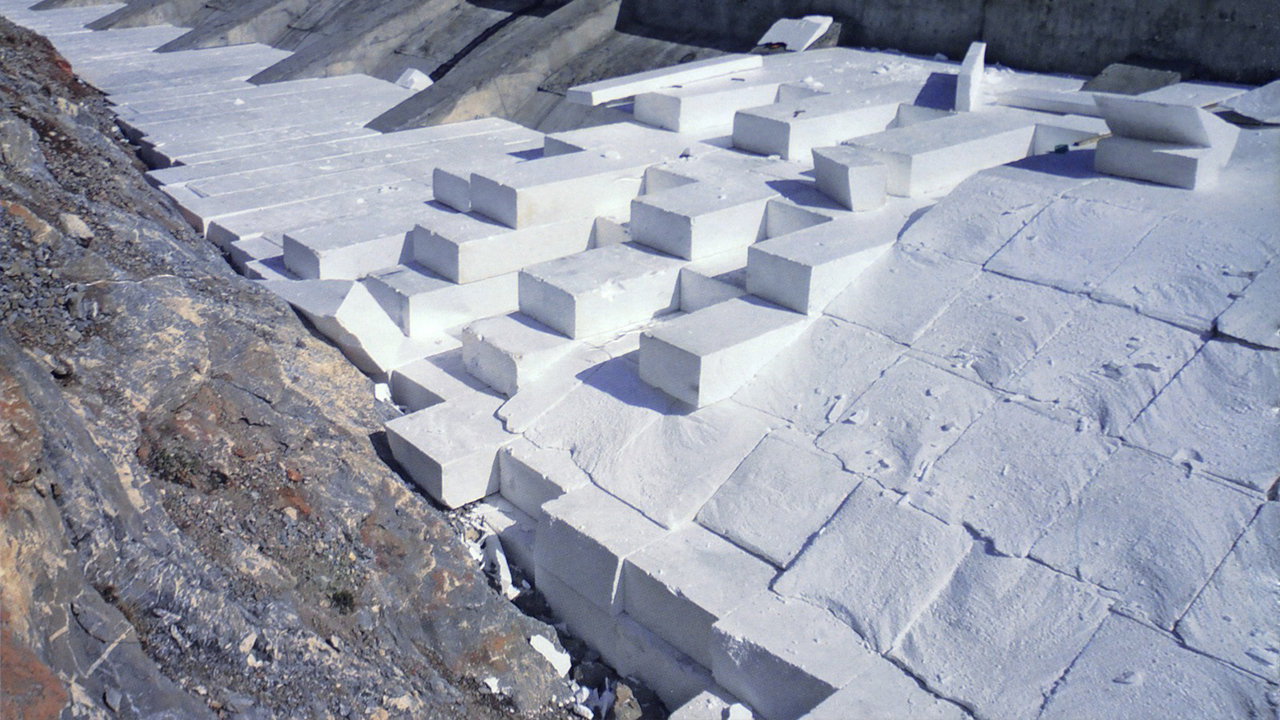
EPS (Expanded Polystyrene) is a foam-type, thermoplastic, closed-cell material with very high thermal insulation value and typically white color, obtained from petroleum. Thanks to its closed-cell structure, it is lightweight, rigid and has very low water absorption. Within the structure of EPS, approximately 3-6 billion tiny closed-cell pores containing trapped stagnant air are enclosed in 1 m3.
98% of the material consists of still and dry air, making it approximately 1% the weight of traditional filling materials. The use of EPS as a lightweight fill material in civil engineering is known as Geofoam. Since the 1960s, Geofoam has been used first in Scandinavian countries and later across Western Europe, Japan, the United States, and many other parts of the world as an alternative lightweight fill material in various civil engineering applications.
Compared to traditional filling materials, its most prominent technical advantages are its light weight, high strength-to-density ratio, easy shapeability, dimensional stability, very low water absorption rate, resistance to environmental factors, cost-effectiveness, and rapid application process. When used, Geofoam significantly reduces the pressure on the ground layers beneath a structure, thereby decreasing the load transferred to the soil. As a result, it minimizes settlement and enhances stability against bearing capacity and slope disadvantages.
Lightweight: Although it is lightweight, it has high compressive strength, and its properties can be adjusted as desired depending on its density. Among the lightweight fill materials used in geotechnical engineering, it has the highest strength-to-density ratio. Depending on the product type, it can withstand approximately 1.5 to 6 tons/m² of load (at 2% deformation) in its bare form, and this strength can be significantly increased with the use of load distribution platforms placed on top.
Strength: Geofoam has a strength range of 1.5–6.0 tons/m², which is roughly equivalent to the load of a 4–5 story building. Considering that a typical road or railway load ranges between approximately 0.5–1.5 tons/m², it provides an ideal strength level for use in road embankments.
Fast: It is very easy and fast to work with, shape, transport, assemble, and apply.
Economical: Compared to traditional ground improvement methods, it is more economical both in terms of initial investment cost and overall project cost.
Eco-friendly: It has closed cells, does not undergo chemical or biological reactions, is not a nutrient for microorganisms, and does not mold, rot, or emit odor. It is an environmentally harmless and recyclable material.
Durable: Due to its closed-cell structure, it absorbs very little water or moisture. It is resistant to environmental factors and freeze-thaw cycles, making it extremely long-lasting.
Maintenance: Compared to traditional methods, road maintenance costs are significantly lower. Its performance remains unaffected by freeze-thaw cycles.
Unaffected by Weather Conditions: It has been used for over 40 years in various parts of the world with diverse climate conditions and has long-term performance records as a proven material.
APPLICATIONS AND COMMON USES OF GEOFOAM
- Road construction on weak soil
- Road widening
- Bridge approach fills
- Buried structures, culverts, and pipelines
- Slope fill in retaining structures
- Landscaping and environmental design applications
- Use as a void filler (formwork)
- Railway embankment fill
