


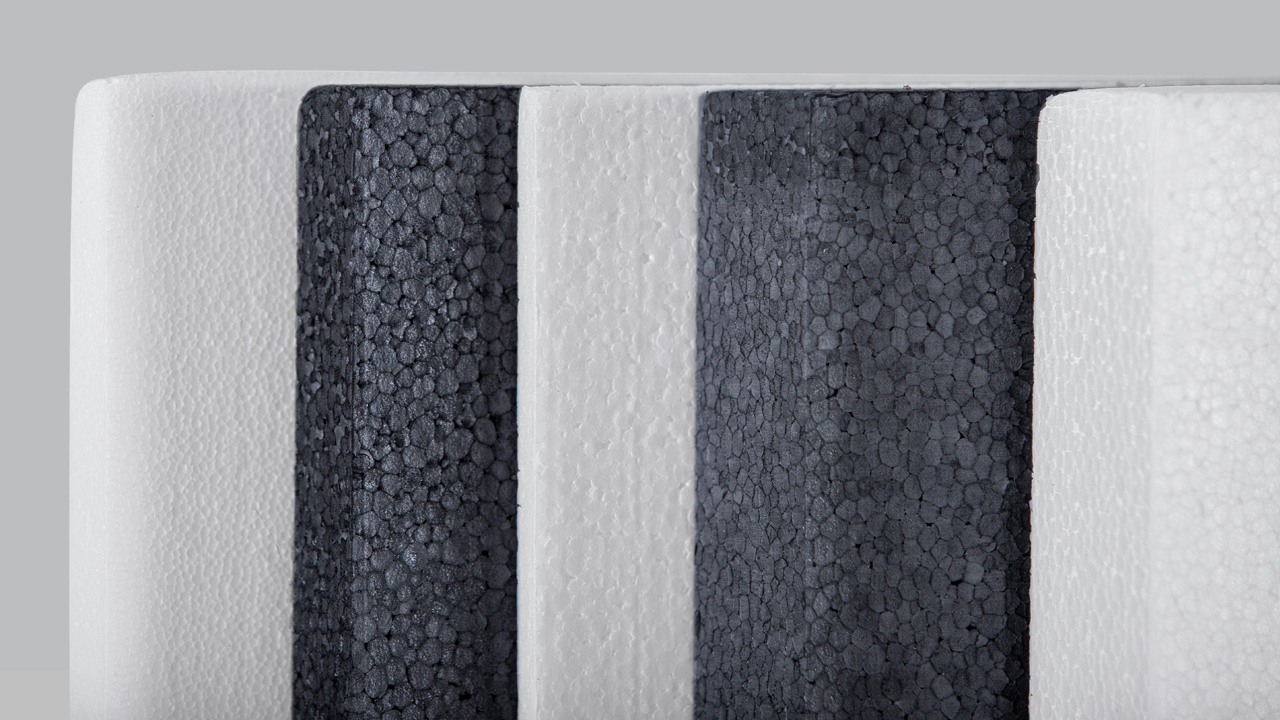
Expanded Polystyrene Rigid Foam (EPS – Expanded Polystyrene Foam) is a foam-type, closed-cell, typically white-colored thermoplastic material obtained from petroleum through the polymerization of styrene monomer. In special productions, there are also products in grey/black tones where the particles are processed to reflect long-wave radiation.
In EPS products obtained by expanding and fusing polystyrene particles, the blowing agent used to expand the particles and obtain foam is 'Pentane'. Pentane, which is an organic component, after enabling the formation of numerous small pores within the particles, exchanges places with air during production and very shortly after production. The released pentane gas converts into CO2 and water vapor-H2O already present in the atmosphere. With the release of pentane, stagnant air becomes trapped in numerous (3-6 billion in 1 m3 of EPS depending on density) small closed-cell pores within the structure of the material. 98% of the material is immobile air,
After the material is supplied as raw material in the form of small particles, it undergoes a pre-expansion process. During this time, the pentane gas inside the particles exchanges places with air, and the desired density of the material is largely achieved at this stage. Then, the expanded particles that are rested in special silos are fused together inside the mold with the help of steam, enabling the material to gain its properties. As a result of the particles fusing with each other, a continuous mass is formed consisting of polygons fused together without gaps in between, with a honeycomb appearance. Subsequent production steps vary according to the material's field of use (as thermal insulation material or as packaging material).
As is known, stagnant air is the most economical, environmentally friendly and excellent thermal insulation material known. The superior thermal insulation properties of EPS are due to the stagnant air contained within its numerous particles. EPS, being one of the few materials in the world that provides the best thermal insulation, is the only material that provides the same performance more economically than other thermal insulation materials used in our country.
The thermal conductivity of EPS varies between 0.033 W/mk and 0.040 W/mk depending on density in white products. As density increases, thermal conductivity decreases. The thermal conductivity of graphite or carbon-containing EPS used in cladding is between 0.031-0.032 W/mk for 16 kg/m3 density.
EPS used in buildings must be non-flame propagating, E class according to European standards and B-1 according to German DIN norm.
EPS is produced in desired densities according to its field of use. Since its properties can be changed in the desired direction with density, it does not cause material waste and unnecessary cost increases. EPS panels, generally used in densities of 15-30 kg/m3 for thermal insulation purposes, are very lightweight. EPS products are used extensively in thermal insulation of structures and in the packaging industry by being given as panels, pipes and shapes.
Technical Properties of EPS
* Styrofoam can also be produced on demand in different densities. |
Example regarding the classification of EPS Panels according to TS 7316 and EN 13163
| EPS TYPE | %10 Deformasyondaki
Basınç Gerilmesi, kPa |
Bending Strength
kPa |
Water vapor diffusion resistance factor µ | Approximate Density
kg/m3 |
Thermal Conductivity
W / mK |
| EPS 50 | 50 | 75 | 20-40 | 16 | 0,039 |
| EPS 60 | 60 | 100 | 20-40 | 17 | 0,038 |
| EPS 70 | 70 | 115 | 20-40 | 18 | 0,038 |
| EPS 80 | 80 | 125 | 20-40 | 19 | 0,037 |
| EPS 90 | 90 | 135 | 30-70 | 20 | 0,037 |
| EPS 100 | 100 | 150 | 30-70 | 21 | 0,037 |
| EPS 120 | 120 | 170 | 30-70 | 23 | 0,036 |
| EPS 150 | 150 | 200 | 40-100 | 26 | 0,035 |
| EPS 200 | 200 | 250 | 40-100 | 31 | 0,034 |
| EPS 250 | 250 | 350 | 40-100 | 36 | 0,034 |
| EPS 300 | 300 | 450 | 40-100 | 41 | 0,033 |
| EPS 350 | 350 | 525 | 40-100 | 46 | 0,033 |
| EPS 400 | 400 | 600 | 40-100 | 51 | 0,033 |
| EPS 500 | 500 | 750 | 40-100 | 61 | 0,033 |
| TS EN 13163 Conformity Table | Unit | Class | Related Standard | |
| Thermal Conductivity Group | 040 | TS EN 12667 | ||
| Density* | 10 | kg/m3 | TS EN 1602 | |
| Thermal Conductivity Coefficient (λ) | 0.039 | W/mK | TS EN 12667 | |
| Water Vapor Permeability (μ) | 20-40 | Kg/m3 | TS EN 12086 | |
| Tensile Strength Perpendicular to Surfaces | ≥ 100 | kPa | TR100 | TS EN 1607 |
| %10 Deformasyonda
Basınç Dayanımı |
≥ 70 | kPa | CS(10) 120 | TS EN 826 |
| Length Tolerance | ± 2 | mm | L2 | TS EN822 |
| Width Tolerance | ± 2 | mm | W2 | TS EN 822 |
| Thickness Tolerance | ± 1 | mm | T2 | TS EN 823 |
| Squareness Tolerance | ± 2 | mm/m | S2 | TS EN 824 |
| Flatness Tolerance | ± 5 | mm | P4 | TS EN 825 |
| Dimensional Stability | ± %0.2 | DS(N)3 | TS EN 1603—1604 | |
| Water Absorption by Long-Term Partial Immersion | ≤ 0.5 | Kg/m2 | Limit Value | TS EN 12087 |
| Operating Temperature | -50 /+75 | °C | ||
| Fire Resistance | Difficult to ignite | E | EN 13501-1 | |
| Dimensions | 60×125 | cm | ||
| Thicknesses | 1-2-3-4-5 | cm |
